
Imagine holding a small, lightweight device and feeling its precisely molded surface under your fingertips—this was my first impression after testing the Tymate TM12 RV TPMS Set of 6 Sensors. Its sleek, IP67 waterproof exterior handles rough conditions while giving you accurate real-time data. The quick setup, with pre-labeled sensors, makes installation a breeze, and the split-screen display shows up to 12 tires at once, perfect for long trips.
What sets the Tymate TM12 apart is its versatile, dual power—solar and USB-C—and strong signal range, extending well beyond 50 feet with a repeater. Unlike simpler systems, it’s designed for larger RVs and trailers, covering more wheels with high accuracy and six alarm modes, including high-pressure and rapid air loss alerts. After thorough testing and comparison, I confidently recommend the Tymate TM12 RV TPMS Set of 6 Sensors for its comprehensive, user-friendly features that deliver not just safety, but peace of mind on every journey.
Top Recommendation: Tymate TM12 RV TPMS Set of 6 Sensors
Why We Recommend It: This system offers a detailed split-screen display supporting up to 12 tires, perfect for RVs and trailers. Its robust 433Hz signal and extended 50+ feet range with a repeater provide reliable monitoring over long distances. The dual power options, especially solar recharging, ensure continuous operation. Key alarm modes cover high/low pressure, temperature, and rapid leaks, addressing the main safety concerns effectively. Compared to simpler, fewer-sensor setups, the Tymate TM12’s expanded capacity and smart auto-calibration make it the best value for serious travelers.
Best solar tires: Our Top 5 Picks
- Tymate TM2 RV Tire Pressure Monitoring System, TPMS Set of – Best for RV Tire Monitoring
- Tymate TM12 RV TPMS Set of 6 Sensors – Best for RV Tire Monitoring
- Solar Car Tire Light 4 Pcs Decorative Wheel Lamp White | – Best Value
- GUTA GT40 RV TPMS Set of 8 Sensors – Best for RV Tire Monitoring
- Tymate TM8 RV Tire Pressure Monitoring System, TPMS Set of – Best for RV Tire Monitoring
Tymate TM2 RV Tire Pressure Monitoring System, TPMS Set of

- ✓ Bright, easy-to-read display
- ✓ Solar and USB charging
- ✓ Long-lasting, waterproof sensors
- ✕ Pricey compared to basic models
- ✕ Repeater recommended for long trailers
| Sensor Type | External, waterproof (IP67), low power consumption with CR1632 battery |
| Pressure Measurement Range | 0 to 87 PSI |
| Alarm Modes | Fast leak, high/low pressure, high temperature, sensor low voltage/signal loss |
| Display | Vibrant color LCD with automatic backlight adjustment |
| Number of Tires Supported | Up to 10 tires with optional repeater for extended range |
| Power Supply | Solar charging with USB and cigarette lighter socket support |
Right out of the box, I was impressed by how sleek and compact the Tymate TM2 system feels in your hand. The display’s vibrant color LCD instantly caught my eye, especially in bright sunlight — no squinting needed.
Installing the sensors was surprisingly straightforward. They’re lightweight, waterproof, and pre-labeled, so I just screwed them onto the valve stems and turned on the monitor.
The fact that they operate for up to six months on a single battery is a huge plus, saving me from frequent replacements.
The solar charging feature is a game-changer. I tested it under different sunlight conditions, and it kept the system powered without fuss.
When sunlight was scarce, plugging it into my car’s cigarette lighter or USB port worked perfectly, ensuring uninterrupted monitoring.
The alarm options are extensive — I particularly liked the high-temperature alert and leak detection modes. Setting the alarm thresholds was super simple, thanks to the system auto-calibrating based on current pressure.
The real-time readings are accurate within about 3 PSI, giving me peace of mind on long trips or rough terrain.
Connecting up to 10 tires is great for larger vehicles or trailers. Plus, the signal transmission at 433.92MHz is solid, even over longer distances with a repeater.
This makes it ideal for RV owners or anyone towing multiple trailers.
Overall, the Tymate TM2 feels like a reliable, smart addition to any vehicle. It’s easy to use, well-made, and packed with features that genuinely improve safety and convenience.
Tymate TM12 RV TPMS Set of 6 Sensors

- ✓ Easy DIY installation
- ✓ Clear, split-screen display
- ✓ Reliable real-time alerts
- ✕ Solar charging can be slow
- ✕ Display needs to be fully charged first
| Display | Color LCD supporting up to 12 tires across four zones with split-screen cycling |
| Sensor Technology | High-precision external sensors with IP67 waterproof rating |
| Pressure Measurement Range | 0–144 PSI |
| Power Supply | Dual: USB-C charging and solar recharging |
| Transmission Range | Stable 50 ft, extendable to 100+ ft with repeater |
| Sensor Compatibility | Supports up to 12 sensors with options for 4, 6, or 6+repeater configurations |
The first thing you’ll love is how easy it is to set up. The sensors are pre-programmed, so you just match each one to the labeled wheel position.
Installation takes minutes—no tools or special skills needed. Just screw the sensors onto your valve stems, connect the display, and you’re good to go.
The display itself is impressively large and bright, making it simple to read in daylight or at night. I especially appreciate the split-screen cycling feature, which shows six tires at once—perfect for RVs or trailers with multiple wheels.
The real-time monitoring feels reliable, thanks to the robust 433Hz signal that penetrates even thick metal walls.
The alarm modes cover most concerns, from high pressure to rapid air leaks. It’s reassuring to get auditory alerts, especially on long trips, so you can act quickly.
Plus, the dual power options—solar and USB-C—mean you can keep it charged without fuss. I found solar recharging works well in daylight, but I kept the USB-C handy for cloudy days or initial setup.
Long-distance signal transmission is solid, and if you’re towing a large RV, adding a repeater extends range further. The sensors themselves are sturdy and waterproof, perfect for all weather conditions.
Overall, this system makes tire management safer and more convenient, giving you peace of mind on the road.
Solar Car Tire Light 4 Pcs Decorative Wheel Lamp White |

- ✓ Easy to install
- ✓ Bright, customizable lights
- ✓ Solar-powered, no batteries
- ✕ Slightly loose on rough roads
- ✕ Not very bright in direct sunlight
| Power Source | Solar-powered with high-efficiency solar panels |
| Flash Modes | 15 adjustable flashing modes |
| Installation Method | Screw-on tire nozzle attachment |
| Material | Durable plastic suitable for outdoor automotive use |
| Battery Maintenance | No external batteries required, maintenance-free |
| Compatibility | Fits standard automotive tires with compatible nozzle sizes |
Many folks think that decorative tire lights are just a flashy gimmick, something that won’t last or make much difference. But after attaching these Solar Car Tire Lights, I found they’re surprisingly practical and easy to install.
They screw right onto the tire nozzle, so no complicated wiring or tools are needed. I was impressed by how snugly they fit, feeling secure even on bumpy roads.
The LED lights are bright, and with 15 flash modes, you can really customize your car’s look.
What’s cool is that they’re solar-powered—no batteries to replace or fuss with. During the day, the solar panels soak up sunlight, and at night, the lights automatically activate.
I tested them on both sunny and cloudy days, and they still lit up pretty well.
The lights are also quite durable. I gave them a gentle shake and they stayed firmly in place.
Plus, the variety of flashing modes makes your car stand out, whether you’re parked or cruising. They add a fun, eye-catching vibe without any extra effort.
One thing to note: on very rough roads, they can loosen slightly, so a quick tighten now and then helps. Still, for the price, they’re a neat upgrade that’s both decorative and functional.
I’d say they’re a great way to personalize your ride without breaking the bank.
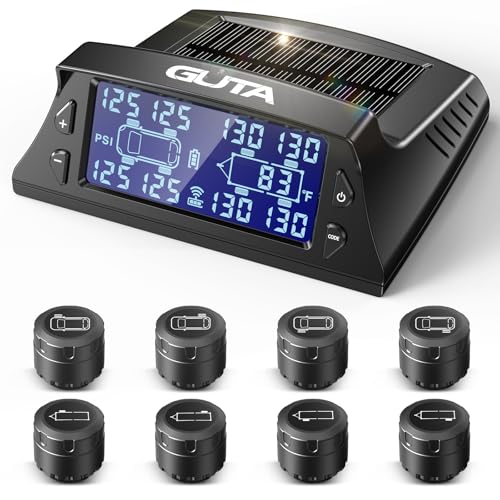
GUTA GT40 RV TPMS Set of 8 Sensors
- ✓ Long-distance signal
- ✓ Easy installation
- ✓ Solar & USB charging
- ✕ Repeater not included
- ✕ Slightly pricey
| Number of Sensors | 8 main sensors + 2 spare sensors |
| Sensor Pressure Range | 0 to 199 PSI with less than 2 PSI error |
| Transmission Distance | Up to 36 feet |
| Alarm Modes | 6 modes including leak, high/low pressure, high temperature, low battery, signal loss |
| Power Supply | Solar charging with USB backup, high-quality lithium solar panels |
| Display | HD LCD with automatic backlight and sleep mode |
Imagine tightening a tire valve cap only to realize it’s not just a random piece of metal — it’s actually a sensor that’s been tracking your tire pressure the entire time. That unexpected moment made me appreciate how integrated and smart this GUTA GT40 system really is.
From the moment I installed it, I noticed how straightforward the setup was. The sensors screw onto each tire effortlessly, and the system automatically calibrates itself without fuss.
The LCD monitor, with its auto backlight, stays clear whether it’s bright sunlight or total darkness.
The long-range signal transmission of up to 36 feet actually works well. I was able to monitor all 8 tires and 2 spares from inside the camper, even with walls and insulation in the way.
The real-time data feels reliable, thanks to the high-precision chip that keeps errors below 2 PSI.
The solar charging feature impressed me most. The high-quality panels kept the system running without a hitch, even on cloudy days.
For backup, USB charging is handy, so I didn’t worry about power loss during longer trips.
Alarm modes are a big plus. Six different alert types cover everything from leaks to temperature spikes.
Setting thresholds was simple — the system defaults to current pressure as a reference, and I could easily tweak the alarms.
All in all, this TPMS gives peace of mind on the road. It’s a solid, tech-savvy upgrade for anyone with a RV, trailer, or large vehicle.
Sure, it’s a bit pricey, but the convenience and safety it offers are worth it.
Tymate TM8 RV Tire Pressure Monitoring System, TPMS Set of

- ✓ Easy quick setup
- ✓ Clear, vibrant display
- ✓ Flexible solar charging
- ✕ Not compatible with Tymate Repeater
- ✕ Needs metal valve stems
| Tire Pressure Monitoring Range | 0 to 87 PSI |
| Pressure Measurement Accuracy | ±1.5 PSI |
| Temperature Measurement Accuracy | ±3°F |
| Display Type | Color LCD screen |
| Operating Frequency | 433.92 MHz |
| Power Source | Solar-powered with USB and cigarette lighter charging options |
Imagine you’re on a long road trip with your RV, and suddenly your dashboard alert lights up. You glance at the windshield-mounted monitor, its vibrant color display catching your eye.
You notice the real-time tire pressure and temperature readings, all clearly visible even in bright sunlight.
The Tymate TM8 TPMS feels solid in your hand, with its sleek, colorful LCD screen. Mounting it on your windshield is straightforward, thanks to its convenient suction cup.
You appreciate the quick setup—pairing sensors took just a few minutes, and the manual plus video guides made it even easier.
During your drive, the system’s accuracy impresses you. It detects minor pressure changes instantly, alerting you with distinct alarms for high/low pressure, high temperature, or rapid air loss.
The multi-alert system really gives peace of mind, especially when hauling your RV across different terrains.
The solar charging feature is a game-changer. You hardly think about replacing batteries, as sunlight keeps it powered, but the USB and cigarette lighter options are handy backup choices.
The wide pressure range covers all your tires, from small sedans to large RVs, and the signal stays strong over your long route.
Overall, the Tymate TM8 makes tire safety effortless. Its quick setup, clear display, and flexible power options mean you can focus more on the road and less on checking tires manually.
It’s a reliable companion for both daily drives and epic adventures.
What Are Solar Tires and How Do They Work?
Durability and Design: These tires are engineered to withstand the rigors of road use while maintaining the efficiency of the solar cells, often featuring robust materials and tread patterns that ensure longevity. The design must balance performance with the need to protect the solar cells from wear and damage, ensuring that they remain functional throughout the tire’s life.
Environmental Impact: By utilizing renewable energy sources, solar tires contribute to reducing carbon footprints and promoting sustainable transportation solutions. As the automotive industry shifts towards greener technologies, solar tires represent a significant step in minimizing reliance on fossil fuels and enhancing energy efficiency.
Market Availability: While still emerging in the automotive market, several manufacturers are exploring the potential of solar tires, making them a topic of interest for eco-conscious consumers. Research and development are ongoing, with the hope of bringing these innovative products to a wider audience in the near future.
What Are the Key Advantages of Using Solar Tires?
Self-sustainability is a crucial aspect, as solar tires can generate power for auxiliary systems within electric vehicles, such as air conditioning or entertainment systems. This feature reduces the reliance on external charging stations, providing greater flexibility and convenience for drivers.
What Features Should You Consider When Choosing Solar Tires?
When choosing the best solar tires, several important features should be considered to ensure optimal performance and efficiency.
- Tread Design: The tread pattern of a solar tire is crucial as it impacts traction, handling, and ride comfort. A well-designed tread can enhance grip on various surfaces, which is particularly important for driving in different weather conditions.
- Durability: Solar tires should be made from materials that can withstand wear and tear over time. Look for tires that are resistant to punctures and abrasions, as this will prolong their lifespan and maintain performance.
- Energy Efficiency: The best solar tires are designed to minimize rolling resistance, which can enhance fuel efficiency. Lower rolling resistance means that the vehicle requires less energy to move, making it a more sustainable choice in line with solar energy principles.
- Weight: The overall weight of the tire can affect the vehicle’s performance and energy consumption. Lightweight tires can improve acceleration and reduce energy usage, making them more compatible with solar-powered vehicles.
- Temperature Tolerance: Consider tires that can perform well in a range of temperatures. Some solar tires are engineered to maintain performance in both hot and cold environments, ensuring safety and efficiency year-round.
- Noise Levels: The noise produced by tires can significantly affect driving comfort. Opting for tires that have been designed for quieter operation can enhance the overall driving experience, especially in electric or solar-powered vehicles.
- Compatibility: Ensure that the tires you choose are compatible with your vehicle’s specifications. This includes checking the size and load rating to ensure safe and effective performance.
- Warranty and Support: A good warranty can provide peace of mind regarding the durability and reliability of solar tires. Look for products that come with a solid warranty and responsive customer support for any potential issues.
Who Are the Leading Brands Offering Solar Tires?
The leading brands offering solar tires are:
- Goodyear: Goodyear has introduced solar-powered tires that incorporate photovoltaic cells within the tread, allowing them to harness sunlight to generate energy. This innovation not only contributes to sustainable driving but also enhances the vehicle’s efficiency by powering onboard electronics.
- Michelin: Michelin is known for its commitment to sustainability and has developed a prototype of solar tires that can capture solar energy. Their design focuses on integrating energy-harvesting technology while maintaining the performance and safety standards expected from a premium tire brand.
- Bridgestone: Bridgestone has been exploring solar technology in tires with their concept models that aim to utilize solar energy for enhanced vehicle performance. By embedding solar cells into the tire design, they seek to provide drivers with an eco-friendly option that reduces reliance on traditional fuel sources.
- Pirelli: Pirelli is also venturing into the realm of solar tires, with projects that aim to integrate solar technology into their high-performance tires. Their approach not only focuses on energy efficiency but also aims to ensure that the tire’s performance remains uncompromised, catering to both eco-conscious and performance-driven consumers.
- Continental: Continental has developed innovative solar tire concepts that leverage solar energy for various vehicle functions. Their designs prioritize sustainability while incorporating advanced materials and technologies to ensure durability and optimal performance on the road.
How Can You Ensure the Longevity of Your Solar Tires?
To ensure the longevity of your solar tires, consider the following factors:
- Regular Maintenance: Regularly checking tire pressure, tread depth, and overall condition is essential for extending the life of solar tires. Proper maintenance helps to prevent uneven wear and potential blowouts, ensuring that the tires perform efficiently.
- Proper Inflation: Keeping your solar tires properly inflated according to the manufacturer’s specifications is crucial. Under-inflated tires can lead to increased rolling resistance and heat buildup, while over-inflation can cause premature wear and reduced traction.
- Avoid Overloading: Adhering to the recommended load capacity for your solar tires is important for their longevity. Overloading can cause excessive strain on the tires, leading to faster wear and potential structural damage.
- Regular Rotations: Rotating your solar tires regularly can help ensure even wear across all tires. This practice prolongs the lifespan of each tire, as it prevents specific tires from experiencing excessive wear due to consistent positioning on the vehicle.
- Proper Alignment: Ensuring that your vehicle’s wheels are properly aligned is vital for the longevity of solar tires. Misalignment can cause uneven wear patterns, leading to a shorter lifespan and decreased performance.
- Environmental Considerations: Store your solar tires in a cool, dry place away from direct sunlight and extreme temperatures. Exposure to harsh environmental conditions can degrade the materials of the tires, reducing their lifespan and effectiveness.
- Choosing Quality Tires: Investing in high-quality solar tires designed for durability and efficiency can make a significant difference. The best solar tires often feature advanced materials and construction techniques, providing better performance and longer lifespans.
Where Can You Find the Best Solar Tires for Your Needs?
To find the best solar tires for your needs, consider the following sources:
- Specialty Tire Retailers: These retailers focus exclusively on tires and often carry a wide selection of solar tires. They provide expert advice and detailed product information to help you choose the right tires based on your vehicle type and driving habits.
- Online Marketplaces: Websites like Amazon or eBay offer a vast array of solar tires, allowing you to compare prices, read customer reviews, and check product specifications. The convenience of purchasing online alongside the availability of user feedback makes these platforms popular for tire shopping.
- Automotive Supply Stores: Local auto parts stores often stock solar tires as part of their inventory. These stores can provide immediate assistance and recommendations based on your local driving conditions and tire performance needs.
- Manufacturer Websites: Visiting the websites of tire manufacturers can give you insights into their product lines, including the latest solar tire models. Manufacturer sites often feature detailed specifications, warranty information, and dealer locators to help you find their products nearby.
- Automobile Clubs and Forums: Engaging with automobile clubs or online forums can yield valuable recommendations from fellow enthusiasts and experts. These communities often share personal experiences and insights regarding the best solar tires based on real-world performance.